On the Web
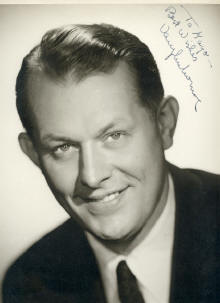
Vaughn Monroe. Despite an early talent for
the trumpet, Vaughn Monroe's desire to become an opera singer eventually landed
him almost ten number one hits during the '40s as well as a host of nicknames
for his rich baritone, including "The Voice with Hairs on Its Chest" and "Old
Leather Tonsils." Born in Akron, OH, Monroe moved to Wisconsin while still a
child and focused on his trumpet talent for most of his boyhood. Another early
ambition, to be an opera singer, resulted in his signing on as a vocalist with
territory bands led by Austin Wylie, Larry Funk (for whom he made his recording
debut) and Jack Marshard. While based in Boston with Marshard, Monroe formed his
first orchestra and began recording for Victor's low-priced Bluebird label. One
of his first singles, "There I Go," spent three weeks at the top of the Hit
Parade in 1940. Though his orchestra was rather tame (even for the time), it was
voted top college band that year. His longtime theme song "Racing with the Moon"
debuted in 1941, and the following year-and-a-half brought no less than three
number one hits: "My Devotion," "When the Lights Go on Again (All Over the
World)," and "Let's Get Lost."
Monroe's first few years of recording had been quite successful, but all his
biggest hits were yet to come. During 1945, "There! I've Said It Again" and "Let
It Snow! Let It Snow! Let It Snow!" both spent more than a month at the top of
the charts. And his two biggest hits, "Ballerina" and "Riders in the Sky," came
in 1947 and 1949, respectively. The latter, an old Western chestnut, presaged
Monroe's attempt at moving into Hollywood's singing-cowboy genre with a couple
of early-'50s B-movies including "Singing Guns" and "The Toughest Man in
Arizona." He also disbanded his orchestra, and continued to work television and
radio (he hosted Camel Caravan for many years). Except for a few mid-'50s
novelties (including "They Were Doin' the Mambo" and "Black Denim Trousers and
Motorcycle Boots"), Monroe never again hit the charts. He worked as a spokesman
for RCA Victor, and continued to perform into the early '70s.
Source: John Bush, All Music Guide
Vaughn Monroe (October 7, 1911 - May 21,
1973) was a singer, trumpeter and big band leader, most popular in the 1940s and
1950s. Monroe was born in Akron, Ohio. He formed a band in Boston in 1940 and
became its principal vocalist.
His signature tune was "Racing with the Moon." He also had hits with "Ghost
Riders in the Sky," "There I've Said It Again," "Ballerina," "Let It Show, Let
It Snow" and "Mule Train." One lost opportunity - he turned down the chance to
record "Rudolph the Red-Nosed Reindeer."
He was tall and handsome which helped him as a band leader and singer, as
well as in Hollywood, although he did not pursue a movie and television career
with vigor. He was sometimes called 'the baritone with muscles.' He was admired
by some and derided by others for both his singing and his persona. He had a
pleasant baritone voice that wasn't always quite good enough for the songs he
sang, according to his critics. He was considered sincere, steady, and
down-to-earth by some; pompous and square by others. In spite of these mixed
opinions, he had a very successful musical career, with a large number of fans.
Monroe died in Stuart, Florida.
Source: reference.com Artist - Vaughn
Monroe Imagine a pop vocalist who looked and sounded like a movie star.
Imagine a tour full of musicians and a bevy of teenage Texas beauties singing
back up. Imagine hit records rocketing to the top of the charts...
Today this would be a recipe for lawsuits, paternity suits,
and drug busts. Back it up 60 years, and you have the rather uneventful,
wholesome touring group known as Vaughn Monroe and his orchestra. The young
ladies were backing vocalists known as The Moon Maids, who doubled as
babysitters for the band members' offspring. They sang about "racing with the
moon," but were about as square as a group of musicians could be. And they
happened to be just about the hottest big band of the late 1940s and early
1950s.
Monroe was a decent horn player who just happened to be
blessed with one of the most memorable singing voices in the history of recorded
music. Not one of the best, for he didn't possess the range of a Crosby or a
Como, and certainly not the timing or styling of a Sinatra. Yet when that
baritone hit the stage, it was magic.
His first hit came relatively early in his career, a song
called There I Go recorded with his first orchestra. Thought of as a
"college act," Monroe was signed to a minor subsidiary of RCA called Bluebird.
Despite the odds, There I Go hit the top of the charts, where it stayed
for three weeks.
Like most big bands of the 1940s, a number of well-known
artists got their start with Vaughn Monroe. Ray Conniff, guitar legend Bucky
Pizzarelli, and songstress Georgia Gibbs all performed with the orchestra.
Although most of the big bands broke up after the 1947 musician's union strike,
Monroe kept on chugging, and went on to record his biggest hit in 1949: Ghost
Riders In the Sky. Eventually the same fate befell Monroe's orchestra. With
the band still at the height of its popularity, concert attendance began to
drop.
Monroe himself attributed the decline to increased expenses,
and above all, television. When expenses drove ticket costs to the breaking
point in 1952, the violins were dismissed. More attrition followed, and Monroe
called the orchestra business quits in 1953. Of the top orchestras from the
1940s, only Guy Lombardo and Count Basie would continue with a sizable show into
the 1960s and 1970s.
With the loss of his touring band, the hit records stopped.
But Monroe's personal popularity was as strong as ever; he continued to be
successful touring as a solo act, using whatever band or orchestra was on the
bill. He was also popular as a pitchman, promoting everything from Camel
cigarettes and RCA radios to the US Forest Service's Smokey the Bear campaign.
Monroe was a spokesman for RCA televisions well into the 1960s. He continued to
headline decent sized showrooms and theatres until his passing in 1973.
From 1940 to 1954, Monroe had close to 70 chart records,
including many #1 hits. Three of those songs, Let It Snow, Ghost Riders
and Ballerina, rank among the all-time top #1 songs, each dominating the
Billboard charts for 10 weeks or more.
Considering Monroe's suave good looks, height, and voice that
could shake the ground, it is surprising that he didn't achieve even greater
fame. Monroe dabbled in cowboy movies in the early 1950s, but he was a city
dweller at heart and not quite comfortable with the role. He was put in the role
of an outdoorsman for the Smokey the Bear campaign, but was a bit too debonair.
Monroe felt at home in front of an orchestra, and although he enjoyed playing
the horn, was smart enough to know that his voice made the show go.
Another part of the legend is that Monroe turned down a few
songs that might've made him an even bigger star. Although a lot is probably
rumor or conjecture, a number of sources have claimed that he was offered first
crack at Rudolph, The Red-Nosed Reindeer, but turned it down. The song
went on to be a massive hit for Gene Autry. If it's true, it probably pleased
fair-and-square Vaughn Monroe, whose hit with Ghost Riders usurped an
earlier recording by Autry. Monroe also recorded an early version of Mule
Train, which was used in one of his westerns, but was slow to promote it as
a single. Frankie Laine would go on to have a huge hit with the song.
Even without these, Vaughn Monroe's roster of #1 hits is quite
impressive:
- There I Go
- Racing With The Moon
- When the Lights Go On Again (All Over the World)
- Let It Snow! Let It Snow! Let It Snow!
- Ballerina
- There, I've Said It Again
- Red Roses For a Blue Lady
- Someday (You'll Want Me to Want You)
- Ghost Riders In The Sky
Source:
popularsong.org
The Story of Vaughn Monroe
1945 Souvenir Booklet. Ohio, Wisconsin, Pennsylvania, Massachusetts and
New York all could claim Vaughn Monroe as their product. And all could support
their claims, because the "life and times" of America's top bandleader ahs given
him roots in many localities.
Vaughn's first home was in Akron, Ohio, where he
was born October 7, 1911. At the time, the senior Monroe was working in a rubber
processing factory, but soon moved to Cudahy, Wisconsin, and later to Jeanette,
Pennsylvania. It was in Jeanette that Vaughn was graduated from high school in
1929. While there he also met Marian Baughman, who is now Mrs. Monroe. At the
senior prom, Mrs. Monroe relates, Vaughn, who had been voted the "boy most
likely to succeed," was supposed to lead the grand march. Ten minutes late,
Vaughn rushed breathlessly into the room and informed Marian that he had just
won a trumpet contest in a nearby town. Which, Marian felt, was "succeeding"
almost too soon.
Vaughn had begun his trumpeting career at eleven.
One day, he calmly walked in to his parents, holding a new trumpet in hand. In
response to their questioning looks, the future "moonracer" explained, "The kid
down the block gave it to me. He can't play it on account of his teeth."
The trumpet turned out to be exceedingly useful.
All through high school and for two years following his graduation, Vaughn was
able to earn and save by working in neighborhood bands. Finally, in 1931, having
saved enough for college, he enrolled at Carnegie Tech's School of Music at
Pittsburgh, where he also took engineering courses, and later at the New England
Conservatory of Music in Boston for further vocal training. While attending
these schools Vaughn continually wavered between his desire to become an
engineer, and the desire to become a concert singer. In 1933, he made his
decision--to quit school and devote all his time to dance bands. In college, as
in high school, he had earned while he learned by playing trumpet with small
bands in his spare time.
Two factors helped Vaughn make up his mind: 1)
although he liked engineering, he didn't think he could be satisfied at it for
his life's work; and 2) despite the fact that his voice teachers told him he had
a big future ahead as a baritone, he had a big frame that had to be fed in the
immediate present.
Vaughn's first job after leaving college was with
Austin Wiley's band. It lasted two years, ending when the band broke up in Ohio.
At the time orchestra leader Larry Funk was playing a date in the vicinity. He
had heard Vaughn on the trumpet, like him and gave him a job.
That's when Monroe took his "boot training" on the
road, for the band did a group of one-nighters that took them from Ohio to
Boston, Colorado, Texas, Kentucky, and back to Boston. "Enough was enough," says
Vaughn. "When we got back to Boston it looked like Paradise to me. I thought it
would be a good idea to settle down there for a few years."
Vaughn got in touch with a friend, Jack Marshard,
for advice. Marshard, at that time, fronted a society band, in addition to
owning several similar units which operated in the Cope Cod area. Not only did
Jack give Vaughn advice, he gave him a job in one of the units. For the next
year and a half Monroe played trumpet, did some vocalizing, and was perfectly
content. Finally, in 1937, the band moved into the "Terrace Gables" in Falmouth,
Mass.
Here Marshard asserted himself. All along Jack had
felt Vaughn belonged out front, not hidden in with the brass section where his
talent was more or less buried. Jack offered Vaughn the choice of either
leaving, or taking the baton. And so--Monroe became a bandleader.
The twelve piece orchestra played the "Terrace
Gables" for the season then moved to a Boston hotel, thence to the
Dempsey-Vanderbilt in Miami, Florida. By this time, Marshard was again
discontent: He wanted the maestro to go into business for himself. The boys in
the band also urged Vaughn to do the same. Talent scout Willard Alexander
entered the picture and he too prevailed upon Monroe to take the leap.
In 1940 Vaughn finally gave in. He disbanded the
Marshard unit at the end of the Miami engagement, asking those who wanted to
join the new band to meet him two weeks later up north. Jack Marshard became
manager, and Alexander was to handle booking. Monroe then got into his car and
without stopping to rest, drove straight to New York. Marian Baughman was
waiting for him there, as was a train to take them to Jeanette, where they were
married a few days later. Almost immediately after the ceremony, the newlyweds
returned to Boston where Marshard had collected the nucleus of the new Monroe
band. Weeks of hectic rehearsal followed.
The new band made its debut in Siler's Ten Acres in
New England. On the night of April 10, 1940, they made their first radio
broadcast--over NBC. RCA-Victor heard a later broadcast, and signed Vaughn
immediately to a record contract.
During the next year, the Monroe band traveled
extensively, playing hotels, theaters, ballrooms and night spots throughout the
New England and Mid-West areas. The husky, masculine tones of Vaughn's voice
soon won him a reputation as a "man's singer," without costing him the loyalty
of his feminine followers. His recording of IF YOU SEE MAGGIE became one of the
nation's top sellers. Since then any number of Monroe records have moved into
this same category. To name a few: SHRINE OF ST. CECELIA; THERE! I'VE SAID IT
AGAIN; LET IT SNOW, LET IT SNOW; and I WISH I DIDN'T LOVE YOU SO. Vaughn
himself, feels that BALLERINA is one of his top performances on records.
The year 1941 really marks Monroe's entry into
big-time. In June of that year he opened at New York's Paramount Theater, and a
few months later took his band into the Century Room of the Commodore. He has
played there every year since, sometimes more than one engagement. To date,
Vaughn has played twelve engagements in all at the Commodore. He says it almost
seems like a "second home" to him.
In 1944, Monroe needed another trombone. After a
long and futile search, Vaughn finally gave up, bought a trombone and taught
himself to play. Now, when the occasion arises, he still stands in with the
trombone section, apparently having deserted the trumpet.
Monroe is a man of many hobbies. He likes
photography, motorcycling, miniature trains, carpentry, swimming, golf, and
especially flying. His earnings are large enough to permit him to be an active
flying enthusiast and he owns two planes--Cantina II and Cantina III (named from
first three and last four letters of his daughters' names). On dates played
within three hundred miles of New York, Vaughn is able to fly home for a visit
on his day off.
He often uses the planes for getting from one
engagement to another. "It gives me extra time for business," says Vaughn, "and
it breaks up the monotony of road life when we're doing one-nighters."
Sometimes, it breaks up the monotony too well. Recently, Vaughn had to make a
forced landing in a Pennsylvania cabbage patch, after being blown about fifty
miles off his course. It's the only time he's been late on a job.
That's a pretty good record for a man who directs
RCA-Victor's top-selling recording band, plays a hundred one-nighters a year,
usually fifteen weeks of theater dates, a dozen other week engagements at night
clubs and the like, and is on the air every Saturday night for Camel cigarettes.
The Monroes, with daughters Candace (born Dec. 13,
1941) and Christina (born Oct. 16, 1944), live in a smart New York apartment on
Park Avenue. Vaughn calls it "home" but with the exception of his long
engagement at Hotel Commodore every year, he sees very little of it.
Back to Top |